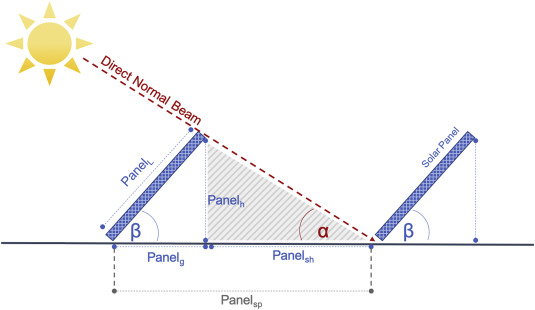
Calculating the correct inter-row spacing for tilted or ground-mounted solar systems is one of the most critical steps in PV layout design. Get it wrong and you’ll have shading losses that underperform the system — and an unhappy customer. Get it right and you might even fit more panels than you thought.
Here’s the complete step-by-step process.
Why Inter-Row Spacing Matters
When solar panels are tilted, each row casts a shadow on the row behind it — especially during winter months when the sun is lower on the horizon. If rows are too close together, shading occurs during peak production hours, reducing system output significantly.
On the other hand, spacing rows too far apart wastes valuable roof or ground space. The goal is to find the minimum spacing that eliminates shading during a defined window — typically 9 AM to 3 PM on the winter solstice.
What You Need Before You Start
- Module width (from panel datasheet)
- Tilt angle of the array
- Site location (latitude/longitude or ZIP code)
- Access to a sun path chart tool (e.g. SunEarthTools.com or PVGIS)
Step 1 — Calculate the Height Difference
The height difference is the vertical rise from the front edge to the back edge of a tilted module.
Formula:
Height Difference = Sin(Tilt Angle) × Module Width
Example:
Module width = 39.41 inches | Tilt angle = 15°
Height Difference = Sin(15°) × 39.41
Height Difference = 0.259 × 39.41 = 10.2″ → round down to 10″
Make sure you are calculating in degrees, not radians.
Step 2 — Find the Solar Elevation Angle
Go to a sun path chart tool and enter your site’s ZIP code or latitude/longitude. Look at the solar elevation angle at 9 AM and 3 PM on the winter solstice — this is your worst-case shading scenario.
Draw a horizontal line across the chart at those times to read the Solar Elevation Angle. In most continental US locations this angle ranges from 15° to 35° depending on latitude.
Example: Solar elevation angle at 9 AM on winter solstice = 17°
Step 3 — Calculate Module Row Spacing
Formula:
Module Row Spacing = Height Difference ÷ Tan(Solar Elevation Angle)
Example:
Module Row Spacing = 10 ÷ Tan(17°)
Module Row Spacing = 10 ÷ 0.306 = 32.7″ → round up to 33″
But we’re not done yet — this spacing assumes the sun is directly south. We need to account for the azimuth angle.
Step 4 — Apply the Azimuth Correction
Look at your sun path chart again. Find the azimuth angles at 9 AM and 3 PM on the winter solstice. Calculate how far each time deviates from true south (180°).
The azimuth correction angle is the difference between south and those morning/afternoon positions. In the example, this turns out to be 44°.
Formula:
Minimum Module Row Spacing = Module Row Spacing × Cos(Azimuth Correction Angle)
Example:
Minimum Module Row Spacing = 33 × Cos(44°)
Minimum Module Row Spacing = 33 × 0.719 = 23.7″ → round up to 24″
That’s 9 inches less than the uncorrected spacing — and on a large commercial system, that difference can allow 27% more panels in the same footprint.
Step 5 — Calculate Row Width (Bonus)
Row width is the distance from the trailing edge of one row to the trailing edge of the next row. This makes CAD layout much easier.
Formula:
Row Width = Minimum Module Row Spacing + Cos(Tilt Angle) × Module Width
Example:
Row Width = 24 + Cos(15°) × 39.41
Row Width = 24 + 0.966 × 39.41
Row Width = 24 + 38.1 = 62.1″ → 62″
Summary of Formulas
- Height Difference = Sin(Tilt) × Module Width
- Module Row Spacing = Height Difference ÷ Tan(Solar Elevation Angle)
- Minimum Row Spacing = Module Row Spacing × Cos(Azimuth Correction)
- Row Width = Min Row Spacing + Cos(Tilt) × Module Width
Inter-Row Spacing in Permit Plan Sets
Your permit plan set must clearly show inter-row spacing on the site plan. Most AHJs require:
- Dimensions between array rows
- Tilt angle notation
- Array layout to scale
- PE stamp verifying structural and layout compliance
Let EnersolConnect Handle Your Ground-Mount Design
Our engineers calculate inter-row spacing, structural foundations, and electrical design for every ground-mount and tilted rooftop system we design. PE-stamped plan sets delivered in 2–5 business days starting from $600.